Janet Boudreau designed the 'I Voted' sticker in 1987 to replace a boring black-and-white mark
The creator of the iconic voting badge explained how a simple blue and red pen design became a national tradition over three decades.
By Chloe Martin ·
Janet Boudreau created the “I Voted” sticker in 1987 because she found the existing election day rewards uninspiring. At the time, Boudreau owned an election supply and voting equipment company. She observed that a county in Washington state was distributing a simple black and white sticker featuring an X in a square. Boudreau said that minimal design failed to excite voters. She wanted a visual that felt more personal and energizing. That dissatisfaction drove her to design a new alternative.
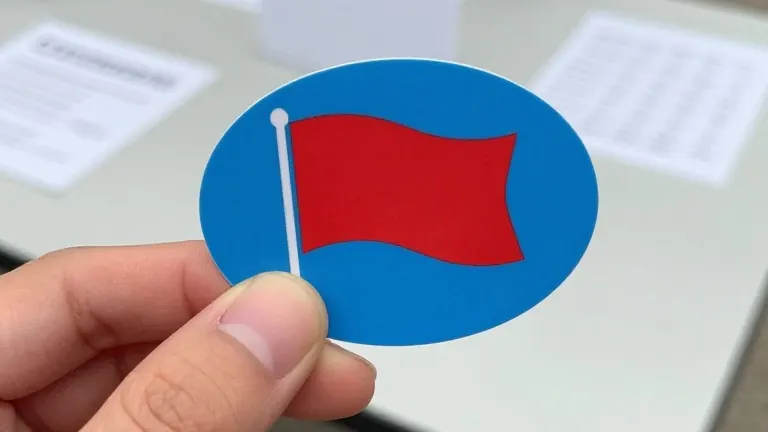
Boudreau returned home and used a blue and red pen to sketch an ellipse with a waving flag. She believed the bright colors and the flag would better capture the spirit of civic duty. Boudreau has long viewed voting as a right and a duty for American citizens to share their voice. She said the process allows people to amplify what they want their world to look like. The new design aimed to make that expression visible and positive. It sought to counter the frustration of people who forgot to participate.
The new sticker began in a few local counties before spreading rapidly across the country. Boudreau recalled the rapid adoption in the early 1990s. She described the growth in 1992 as intense. The sticker became a standard item at polling places nationwide. Its popularity outpaced the original black and white version. It joined a long history of election day memorabilia. That history includes pins, buttons, and ribbons used in the women’s suffrage movement of the 1920s.
Since its introduction, the sticker has evolved in various ways. State specific images and patches for future voters have appeared. Contests have also invited children to design their own versions. Boudreau said the core goal remains to inspire Americans to vote. She noted that the sticker has become a badge of honor for participants. It serves as a visual confirmation of civic engagement. It acts as a promise and a call to action for each election cycle.
Boudreau expressed hope that the sticker will continue to carry this meaning. She encourages people to get out and vote and then spread the word. The design has endured for nearly four decades. It remains a familiar symbol at polling stations. Boudreau’s original sketch transformed a local experiment into a national tradition. The simple ellipse and flag now represent a widespread civic habit. It stands as a tangible reward for participating in the democratic process.
The creator’s motivation stemmed from a desire to improve the voter experience. She saw the original county sticker as too plain. Her blue and red design offered a more engaging option. The shift from a local test to a national standard took less than five years. By 1992, the sticker was widely recognized. Boudreau’s company helped supply the initial distribution. The design’s simplicity allowed for easy reproduction. It became a standard feature of election day logistics across the United States.
Source: WXIX-TV