70 House Districts Face Six-Figure Ad Wars in Final Week
Campaign spending data reveals a wide range of competitive races, with over $10 million poured into key districts in Michigan, North Carolina, New York, and Florida.
By Bianca Ricci ·
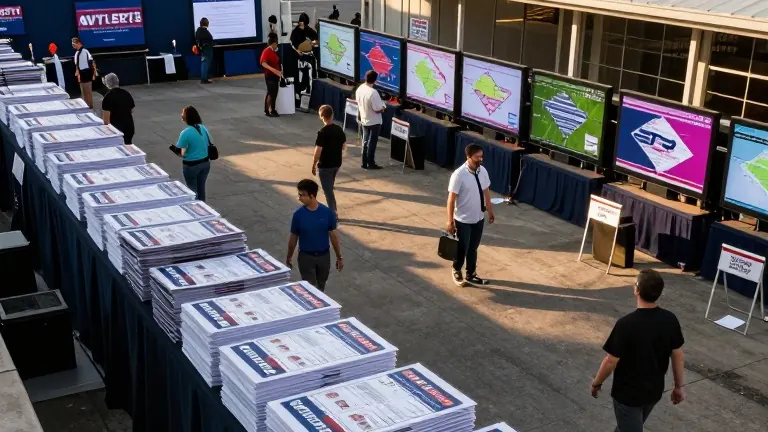
Campaign finance data indicates that 70 House districts will receive at least six figures in advertising from both major parties before the November 3 election. This spending pattern suggests the central contest is no longer about preventing a Democratic shift in the House, but rather determining the scale of that shift. The final competitive map is expansive, covering a diverse set of geographic and political profiles.
The financial commitment is concentrated in specific high-stakes areas. Michigan, North Carolina, New York, and Florida each feature toss-up districts receiving more than $10 million in final-day messaging. Significant sums are also being deployed in deep-red communities in Tennessee, Oklahoma, and Arkansas, as well as in districts where recent redistricting decisions by Republicans may impact outcomes.
The current political environment favors the party not in power. With Republicans holding a narrow 218-214 seat advantage, recent ratings from the Cook Political Report indicate Democrats are favored in 220 seats. Additionally, 17 races are designated as toss-ups, and 30 others lean toward the GOP but remain potentially competitive. This shift reflects a broader trend where seats that were narrowly won by one party’s presidential candidate in 2024 have moved toward the opposing party’s House nominee.
Specific districts illustrate this volatility. Republicans have reduced ad reservations in recent weeks in districts held by Democratic Representatives Adam Gray (CA-13), Nellie Pou (NJ-09), and Marie Gluesenkamp-Perez (WA-03). Similar cuts are occurring in the seat of retiring Republican Representative Don Bacon (NE-02). Polling data from NPR, PBS News, and Marist shows Democrats maintaining a 10-point lead among registered voters and an 8-point lead among likely voters on the generic congressional ballot.
Voter concerns regarding the cost of living, including rising gas prices and tariffs, remain the primary economic issue. These factors coincide with a record number of congressional retirement announcements and an anti-incumbency streak in primary elections. A mid-decade redistricting effort, following a Supreme Court decision that altered parts of the Voting Rights Act, further reshaped the map. Republicans adjusted boundaries to add conservative voters to districts held by Representatives Marcy Kaptur (OH-09), Don Davis (NC-01), Shomari Figures (AL-02), and Darren Soto (FL-09).
Democrats executed similar moves in California, affecting districts held by Republican Representatives James Gallagher (CA-01), David Valadao (CA-22), Ken Calvert (CA-41), Darrell Issa (CA-48), and Independent Kevin Kiley (CA-06). Among the four districts affected by Republican redistricting, only Figures and Soto are currently rated as favoring the GOP. The most expensive races include Michigan’s 7th and North Carolina’s 1st Districts, each with over $12 million in planned spending, alongside Florida’s 14th, 22nd, and 25th Districts, New York’s 17th, and Iowa’s 2nd and 3rd.
In total, the 70 districts with six-figure ad spending from both parties voted for Donald Trump by an average of nine points in 2024. Sixty of these districts are listed as priorities by both the Democratic and Republican House campaign arms. The Democratic Congressional Campaign Committee’s list of districts in play includes seats where Trump received closer to 60% of the vote in 2024, areas that have seen little to no advertising from either party.
Source: WVIZ