Chicago Infrastructure: Record Sewage Flows into the River
Heavy rains forced the Racine Avenue pumping station to release over 10 billion gallons of untreated wastewater into the Chicago River this year.
By Bianca Ricci ·
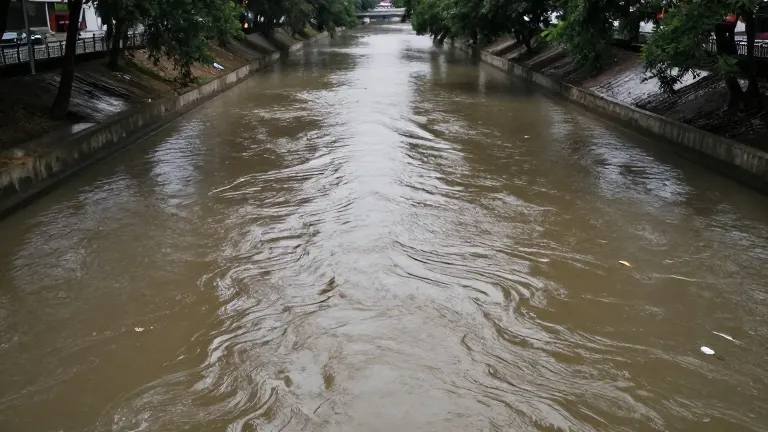
The South Branch of the Chicago River, specifically the section known as Bubbly Creek, is currently dealing with a volume of untreated sewage that has not been seen since 2019. The Metropolitan Water Reclamation District of Greater Chicago reports that heavy rainfall has overwhelmed the system's capacity to process waste before it reaches the waterway.
The Racine Avenue pumping station, located south of the Bridgeport Art Center, is the primary source of these discharges. The facility handles both wastewater and stormwater, moving the combined flow to a treatment plant. However, when rain intensity exceeds the system's limits, the station must release raw sewage directly into the river to prevent backups that would flood local homes. In Chicago, stormwater and wastewater share a single sewer infrastructure, a design that complicates management during heavy storms.
Joe Gamble, who works at the Chicago Maritime Museum, describes the physical impact of the discharges on the shoreline. After large storms, layers of feces, condoms, tampons, and other flushed items float down the river and become trapped in the low-hanging trees along the bank. Gamble noted that the smell is persistent, often clinging to his clothing even after he has left the area. Residents have given the abundant condoms a local nickname, calling them Chicago whitefish.
The release of this water carries health and environmental risks beyond the immediate nuisance. The untreated sewage contains bacteria and pathogens that pose a danger to individuals with weakened immune systems. The influx of contaminants also disrupts the local ecosystem, frequently wiping out fish populations in the affected area for weeks at a time.
The water eventually travels from the Chicago River to the Chicago Sanitary and Ship Canal. From there, it flows into the Des Plaines and Illinois rivers before reaching the Mississippi River and the Gulf of Mexico. The Metropolitan Water Reclamation District operates the pumping station and manages the flow of this water through the regional waterway network.
This infrastructure issue stands in contrast to other recent developments in the city and region. In a separate matter, the Art Institute of Chicago is hosting an exhibit on Mary Cassatt that highlights a missing mural she created for the 1893 World's Fair. The three-panel piece, titled Modern Woman, vanished after the fair ended, with the last known record placing it in Chicago in 1912.
Meanwhile, in the suburbs, the Barrington community continues to draw attention for its history, which includes a 1934 machine-gun battle on the Northwest Highway involving Baby Face Nelson and FBI agents. The town, with a population of roughly 10,000, is known for numerous ghost stories tied to these historical events. Tour guide Larry Arroyo, who leads tours at the Old Joliet Prison, believes such spirits exist due to unresolved matters or injustices in the deaths of the individuals.
In the scientific community, researchers at Northwestern University have announced a breakthrough in antimatter research. Physicists used electric and magnetic fields to trap a single positron, the antimatter counterpart of the electron. Gerald Gabrielse, the lead author of the study published in Physical Review Letters, stated that the experiment allows for the study of antimatter in a controlled quantum state for months. This research aims to address questions regarding the formation of the universe after the Big Bang.
The housing sector in Illinois is also under review as the city faces a continuing crisis. The Gautreaux Assisted Housing Program, which began in 1966, was a court-ordered initiative to help low-income residents move from segregated communities to mixed-income neighborhoods. The program ended after moving 7,100 families, a target set by the courts. Advocates argue that more resources are needed to support similar mobility programs, as many voucher holders remain in substandard conditions in segregated areas.
As Halloween concludes, the region prepares for Día de Muertos, observed on November 1 and 2. The holiday, rooted in Mesoamerican and Spanish Catholic traditions, involves families setting up ofrendas with marigolds, photos, and food for deceased relatives. The tradition has expanded into Chicago, where various neighborhoods host celebrations to honor ancestors during the days when the veil between the natural and spiritual worlds is believed to thin.
Source: WBEZ Chicago