Cincinnati Musicians Sustain Three Distinct Classical Traditions
Local ensembles and educators in the region preserve Persian, Chinese, and Carnatic musical forms through regular performance and instruction.
By Pablo Kuznetsov ·
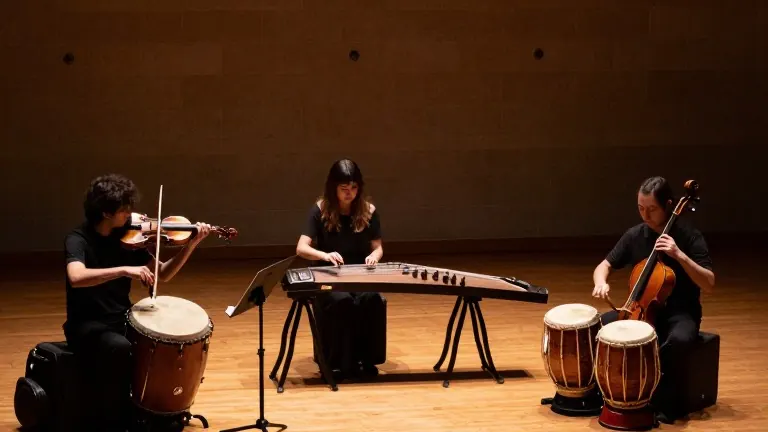
Classical music in the Cincinnati area extends well beyond the Western repertoire. Three distinct traditions, Persian, Chinese, and Carnatic, are actively maintained by local musicians who perform, teach, and collaborate within the community. These groups operate with a focus on preserving specific cultural art forms while integrating into the local arts scene.
The Cincinnati Persian Music Ensemble has functioned as a core part of the city's musical output for nearly four decades. Founded in 1987 by cardiologist Dr. Freidoon Ghazi, the group has performed at the College-Conservatory of Music's Corbett Auditorium and at various Iranian community events. Siavash Mostajabi, a tombak player for the ensemble, stated that the group provides a space for musicians to practice and keeps the tradition alive for community members.
The ensemble includes specific instrumentalists and vocalists dedicated to Persian performance. The current lineup features Freidoon Ghazi on violin, Ali Razavi on lead vocals, Siavash Mostajabi on tombak, Nadia Kardgar on backup vocals, Trinity Lê on piano, and Shuo Feng in a Chinese-US capacity. Ghazi studied Western classical performance in Iran, while Razavi developed his vocal skills in America under opera director George Gibson. The violin used by the ensemble serves as a distant relative to the Persian kamancheh, allowing it to play Persian modes effectively.
In the field of Chinese classical music, Shuo Feng operates the Chinese-US Cultural Exchange Academy. She teaches guzheng and Chinese language at her studio. Feng has forty years of experience in the instrument and has brought educational presentations to the College-Conservatory of Music, Purdue University, and various K-12 schools in the Midwest. Her studio focuses on inviting new students to learn the guzheng and explore Chinese culture.
Carnatic classical music is represented in the area by a trio that recently collaborated for the first time. The group consists of Malathy Vijay on vocals, Sumant Anantharam on mridangam, and Aadhivan Ramkumar on violin. Vijay teaches Carnatic vocal performance at the Ragavardhini School of Music in Mason. Anantharam, a multi-instrumentalist, is new to the Cincinnati community and is currently working to build a studio in the area. Ramkumar is a Carnatic violinist and an alumnus of the music composition program at the College-Conservatory of Music.
The violin has a specific history in these musical exchanges. It was brought to South Asia through British colonization and has since been adapted into the Carnatic tradition. This instrument shares a lineage with the Persian kamancheh, creating a cross-cultural link between the Persian and Carnatic performers in the region. The guzheng has similarly traveled to music schools and classrooms across the Midwest, contributing to local music education.
These artists maintain their practices through regular performance and teaching. The Persian ensemble performs at conservatory halls and community events. Feng holds classes at her academy and presents at schools. The Carnatic musicians collaborate on improvisations and compositions. This activity ensures that these specific classical traditions remain present in the Cincinnati musical community.
Source: WGUC