Engineers Warned Arizona 60 Years Ago: The Canal Needs Backup Water
A new federal plan threatens to cut Central Arizona Project supplies by 47%, a scenario designers predicted in the 1960s but never fully addressed.
By Bianca Ricci ·
The Colorado River supplies water to nearly 40 million people across seven Western states. Right now, the river is running dry because more water is being taken out than the system can provide, leaving policymakers and users in a state of high-stakes tension.
This autumn, a new federal plan to reduce water use triggered legal action from Nevada, Arizona, and the massive canal system that delivers water to the Phoenix area. The plan could cut the amount of water allocated to the Central Arizona Project, or CAP, by 47 percent. That projection has turned heads, but water experts say the warning was not new.
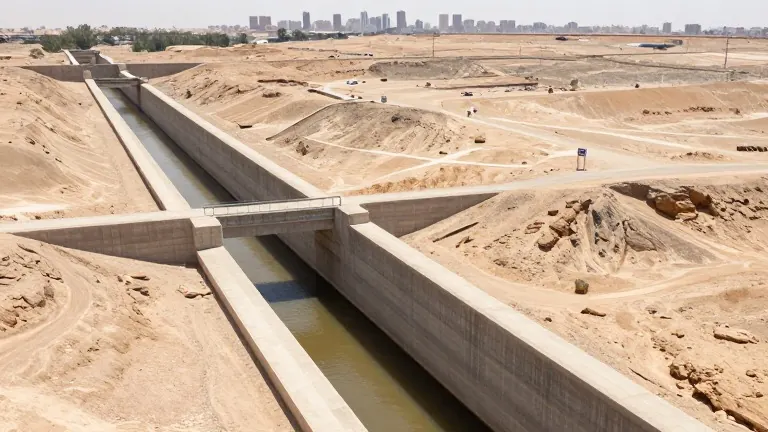
The Central Arizona Project is a 336-mile network of canals, pipelines, and pumping plants that transports water through the desert to Phoenix and Tucson. Rich Weissinger, who spent nearly 30 years with the organization that operates the canal, described the facility as an engineering marvel. He noted that the system relies on stable, reliable water sources for the many industries, municipalities, and residents that depend on it.
However, the reliability that made the system possible is now in question. Record-breaking drought conditions and climate change have pinched water supplies across the basin. In response, the nation’s two largest reservoirs have shrunk to record lows, forcing a difficult choice between maintaining current supply levels and reducing demand.
The current crisis mirrors warnings issued by the project’s architects in the 1960s. Floyd Dominy, then commissioner of the Bureau of Reclamation, forecasted that available supplies for the project would be more than halved between 1990 and 2030. He predicted these declines would result from growing use in upstream states like Colorado, New Mexico, Utah, and Wyoming. Although the primary driver of modern shortages has turned out to be drought, the core prediction of lower flows proved correct.
In 1968, Arizona Congressman Mo Udall told Congress that the project required additional water, or augmentation, to survive. He suggested connecting the Colorado River system to the Columbia River in the Pacific Northwest or building desalination facilities on the Pacific Coast. To appease senators from the Pacific Northwest, the legislation included a clause barring the federal government from studying such inter-basin transfers for ten years.
Those suggestions were largely ignored for decades. Tom McCann, a former deputy general manager for the CAP, said there was no willingness to spend money on a future problem that had not yet materialized. He explained that while managers continued to study augmentation options, cost and political hurdles prevented implementation. The warning was not completely written off, but the severity of the shortage was not fully anticipated.
Brad Udall, a senior water and climate research scientist at Colorado State University and the son of Mo Udall, offered a different perspective on the historical oversight. He suggested that the optimism of the post-World War II era led policymakers to believe they could engineer their way out of any crisis. The negotiations for the canal also followed a long legal battle between Arizona and California, which left proponents eager to finalize the project without solving every future variable.
Chuck Podolak, former director of the Water Infrastructure Finance Authority of Arizona, argued that promising expensive infrastructure like desalination allowed policymakers to avoid a harder conversation. Farms and ranches account for roughly three quarters of all Colorado River water use. Buying water from agricultural users is generally more affordable than building new major infrastructure, but it requires acknowledging that urban growth often comes at the expense of farming.
The debate over whether the 1960s leaders made a mistake by ignoring their own warnings continues. For now, the legal actions and the threat of steep cutbacks have placed the future of the Central Arizona Project back in the spotlight.
Source: WVIZ