Nine Dead in Greenacres Learjet Crash as NTSB Investigates
All passengers and crew were killed when the aircraft broke up in mid-air before hitting a residential street in Florida.
By Chloe Martin ·
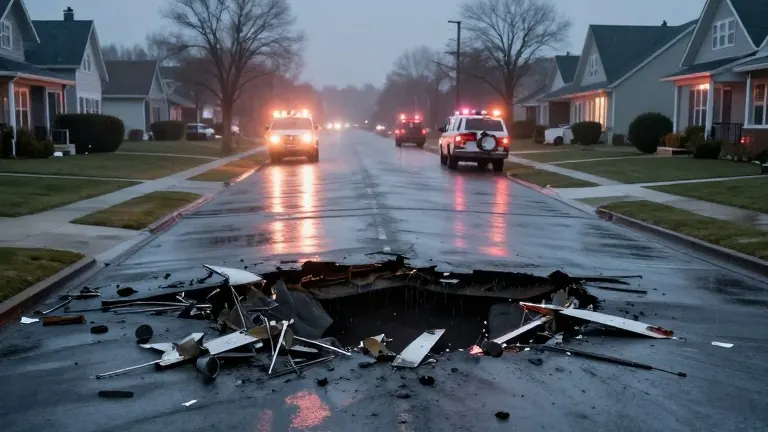
Nine people died when a Learjet crashed into a residential street in Greenacres, Florida, on Sunday, November 1. The aircraft exploded upon impact, killing all occupants on board. A family representative confirmed the identities of the passengers in a statement posted on Facebook. The victims were Adam Robinson, Helen Sharp, their children Emma and Charlie, Rachael Reed, Charmi Fehr, and Anita Maria Cetina.
The crash followed a sequence of mechanical and environmental issues that investigators are now examining. Prior to the impact, one pilot reported icing conditions at high altitude to air traffic control. The second pilot, Nathalia Gadelha Filgueiras, was identified by her mother. The identity of the second pilot remains unconfirmed. The aircraft was originally equipped with a cockpit voice recorder, which federal investigators hope to recover to determine the cause of the failure.
National Transportation Safety Board member Tom Chapman addressed the media on Monday regarding the early findings of the probe. He stated that evidence suggests the aircraft began breaking apart before it struck the ground. Chapman noted that debris may be scattered over a wide area, making the recovery process complex. He emphasized that determining the specific weather conditions at 35,000 feet is a primary focus of the investigation.
Aviation safety expert Jeff Guzzetti provided technical context for the crash dynamics. He suggested that key tail components may have been lost during turbulence or the subsequent nose dive. Guzzetti explained that losing these components renders the plane uncontrollable, potentially explaining the steep descent observed before impact. Weather radar data from FlightRadar24 indicates the plane flew into a rapidly expanding storm cell, a detail NTSB investigators are currently verifying against flight records.
NTSB investigator Timothy Monville described the scene as a multi-day operation. The primary challenge for the team is recovering the major wreckage from the crater left on the roadway. Monville stated that the process involves detailed on-site work to piece together the sequence of events. Investigators are continuing their search for scattered parts while analyzing the available data from the flight.
Rain was heavy in the region on Sunday, contributing to the challenging conditions for both the pilots and the first responders. The crash site is located near West Palm Beach. Local authorities have secured the area as federal teams work to clear the debris and gather evidence. The investigation remains active as officials work to confirm the final details of the accident.
Source: WQCW