NASA Swift Observatory reenters atmosphere Wednesday morning
The 3,200-pound spacecraft will burn up over a latitude band spanning 41 degrees, with NASA estimating a 1 in 2,100 probability of ground harm.
By Bianca Ricci ·
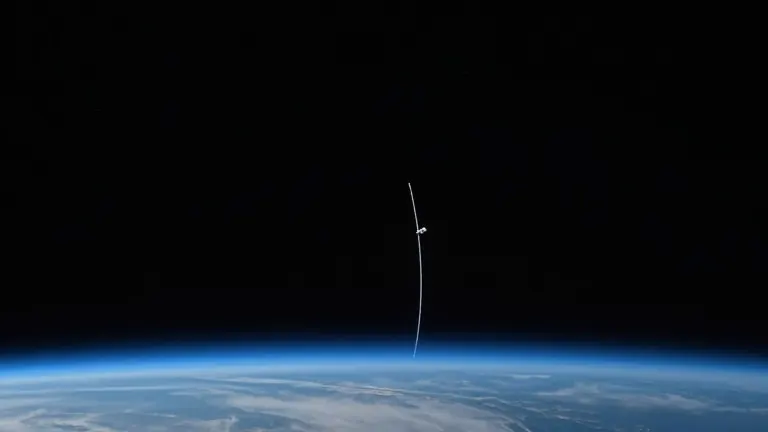
NASA’s Neil Gehrels Swift Observatory is scheduled to reenter Earth’s atmosphere early Wednesday morning, marking the end of a 22-year mission. The agency expects most of the 3,200-pound spacecraft to disintegrate as it passes through the dense lower layers of the atmosphere, though some structural components will survive the descent.
In a statement released Monday, NASA calculated the probability of injury to people on the ground at approximately 1 in 2,100. The predicted impact zone stretches between 20.6 degrees south and 20.6 degrees north latitude. This corridor covers approximately 1,420 miles of surface area, including parts of Central and South America, Central Africa, southern India, Southeast Asia, northern Australia, and major oceanic regions.
Precise timing for the reentry remains uncertain due to standard model margins of error. The nonprofit Aerospace Corporation estimated the event would occur at 5:19 a.m. ET, plus or minus two hours. A more recent projection from the US Space Force placed the reentry time at 7:42 a.m. ET with the same two-hour variance.
The spacecraft’s rapid descent was accelerated by increased solar activity during the 2024 peak of the sun’s 11-year cycle. Intense flares and coronal mass ejections caused Earth’s atmosphere to expand, which increased aerodynamic drag on the observatory. This drag pulled Swift down to an altitude of 171 miles, a point where it could no longer maintain its orbit and entered safe mode.
A rescue mission launched in July by Katalyst Space Technologies aimed to extend the observatory’s life by a decade. The company built a spacecraft named LINK to grapple Swift and boost it to a stable orbit. The effort failed weeks after launch when LINK spun out of control before making contact. Penn State University, which houses the Mission Operations Center, sent a final command to terminate operations on October 20.
Current orbital debris standards, updated in 2019, require uncontrolled reentries to carry an expected casualty rate of less than 1 in 10,000. Parker Wishik, a spokesperson for The Aerospace Corporation, noted via email that this metric refers to serious injury or death. Swift, launched in 2004, predates these stricter guidelines. If the observatory were launched today, it would likely face tighter end-of-life planning requirements.
NASA has begun seeking similar solutions for the Hubble Space Telescope. The agency issued a Request for Proposals to commercial firms asking for methods to boost or service Hubble. According to the RFP, there is a 10% chance Hubble will exit orbit by 2032 and a 50% chance it will deorbit by 2033. No replacement for Hubble is expected before the 2040s.
Source: ABC7 Chicago